
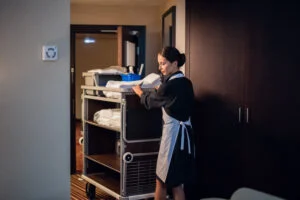
Guests rarely see the system behind a hotel room. They see whether the room is ready, whether it feels clean, and whether the hotel responds responsibly when it is not.
That makes cleanliness both an operational function and a trust signal. A clean room supports comfort and confidence. A missed detail can cause a guest to question surfaces they cannot inspect, while a delayed room can shape the experience before the stay begins.
The practical issue is not whether housekeeping teams care. It is whether the operation gives them enough capacity, coordination, information, and control to produce a reliable result under changing conditions.
Cleanliness is produced by a sequence, not one task
A guest room normally moves through several connected stages:
1. The prior guest departs and the room becomes accessible.
2. The room’s condition and special requirements become known.
3. Linen, supplies, equipment, and labor reach the room.
4. Cleaning and room resetting are completed.
5. The room is inspected or otherwise verified.
6. Deficiencies are corrected.
7. The room is released as ready.
The room attendant controls only part of this sequence. Late departure, unavailable linen, a maintenance condition, incorrect room status, delayed inspection, or a missing amenity can prevent release even when the cleaning itself is performed well.
Hotels therefore need to manage room readiness as a coordinated outcome rather than treat every delay as an isolated housekeeping failure.
Turnover pressure concentrates risk
Most hotels face a concentrated period between departures and arrivals. The exact times vary by property, but the operating challenge is the same: many rooms become available within a limited window, and demand for ready rooms rises quickly as check-in approaches.
During that period, housekeeping may need to strip and remake beds, clean bathrooms, remove waste, dust and wipe surfaces, vacuum or mop, replenish amenities, report damage or maintenance conditions, and prepare each room for verification.
The schedule becomes less predictable when guests leave late, rooms require more recovery than expected, early arrivals increase, or access and supply problems occur at the same time. A plan based only on an average number of minutes per room can conceal that variability.
Not all rooms require the same amount of work
Room condition varies. A lightly used room may move through the sequence efficiently. Another room may contain spills, excessive waste, odors, damaged items, missing inventory, or a maintenance problem that prevents release.
The difference matters because averages work across a large group of rooms, while operations occur one room at a time. Several high-effort rooms assigned to the same employee or discovered late in the turnover period can create a backlog even when the average workload looked reasonable.
Supervisors need a way to identify exceptions early, rebalance assignments, dispatch support, and separate cleaning work from conditions that require engineering, pest control, laundry, or management decisions.
The hidden constraints behind room readiness
Linen and supply flow
Clean linen, towels, amenities, chemicals, and working equipment must be available where and when attendants need them. Shortages or long retrieval routes reduce productive cleaning time and can leave otherwise completed rooms waiting for final items.
Accurate room status
Housekeeping and the front desk need a shared understanding of departures, stayovers, priority arrivals, unavailable rooms, and rooms awaiting inspection or maintenance. Incorrect status information causes duplicated travel, delayed starts, and premature promises to guests.
Maintenance coordination
A room may be clean but not ready because of plumbing, HVAC, lighting, furniture, pest, odor, or damage concerns. The operating plan should define how attendants report these conditions, who owns the response, and when the room can be released.
Inspection and release
Inspection should protect the guest without becoming an uncontrolled bottleneck. The hotel should define which rooms require review, what the reviewer checks, how deficiencies are communicated, and who confirms closure.
Public areas and occupied-hour demand
Guest experience is not confined to bedrooms. Entrances, elevators, corridors, restrooms, fitness areas, meeting spaces, and food-service approaches continue to receive traffic while room turnovers are underway.
A coordinated hotel cleaning service should distinguish room-turnover responsibilities from public-area maintenance so that one visible priority does not quietly displace another.
Why adding staff alone may not solve the problem
Additional labor can be necessary when the required workload exceeds available capacity. But headcount does not correct inaccurate room status, poor supply flow, unclear assignments, delayed inspection, or maintenance decisions that remain unresolved.
Hotels should first identify the constraint. If workload is the problem, responsible How to Allocate Cleaning Time and Staffing in Commercial Facilities can translate room mix, occupancy, service standards, public-area responsibilities, and turnover demand into capacity. If coordination is the problem, adding people to the same unclear process may increase movement without increasing ready rooms.
The right question is not simply whether more people are needed. It is what currently prevents a room or area from reaching the intended condition on time.
How cleaning problems become review problems
Guests do not need to understand the cause of a failure to experience its consequences.
Review-triggering conditions may include:
- A room that is unavailable at the promised time
- Hair, dust, residue, waste, or odor that remains after release
- A bathroom or bed condition that undermines confidence
- Different cleanliness standards across rooms or stays
- Public areas that deteriorate during occupied hours
- A complaint that requires repeated explanation or follow-up
- A response that defends procedure before protecting the guest
One defect does not automatically determine the entire stay. The hotel’s response affects how the guest interprets what happened.
Recovery can protect trust after a failure
A strong recovery process begins by acknowledging the observed condition, protecting the guest, and assigning corrective action. The hotel should then verify that the correction occurred and determine whether the issue was isolated or evidence of a system weakness.
For example, re-cleaning one bathroom may resolve the immediate concern. If similar residue appears in several rooms, the hotel may need to examine method, product, equipment condition, training, inspection, or workload.
This is the difference between correcting a room and learning from a failure. A proactive cleaning system uses complaints as evidence without waiting for the same problem to reach additional guests.
What reliable hotel cleaning operations do differently
Reliable operations generally make the following controls visible:
- Room standards are defined in observable terms.
- Assignments reflect departures, stayovers, room type, and expected variability.
- Linen and supply availability are coordinated with the turnover plan.
- Attendants can report exceptions without being blamed for discovering them.
- Maintenance and cleaning responsibilities are separated but connected.
- Priority changes are communicated through one controlled channel.
- Inspection verifies critical conditions and closes deficiencies.
- Public-area responsibilities remain protected during room-turnover pressure.
- Recurring failures are reviewed for causes beyond the individual room.
The objective is not perfection or more paperwork. It is a repeatable operation that detects variation before the guest has to manage it.
Measure the operation before reviews decline
Guest reviews are valuable but delayed. They reveal what reached the guest, not every condition the hotel corrected beforehand.
Operational indicators can include:
- Rooms released by the required time
- Rooms returned for correction and the reason
- Time between cleaning completion, inspection, and release
- Linen or supply delays
- Maintenance holds discovered during cleaning
- Repeat deficiencies by room, floor, task, or shift
- Public-area complaints during peak periods
- Guest complaints resolved without repeat contact
Hotels should measure cleaning performance beyond complaints so that improvement begins with operational evidence instead of waiting for a lower rating.
Questions hotel operators should ask
1. Which condition most often prevents rooms from being released on time?
2. Can attendants identify high-effort rooms early enough to rebalance work?
3. Are linen and supplies available without excessive travel or waiting?
4. Do the front desk and housekeeping share accurate room status?
5. Which conditions require maintenance, and how is closure confirmed?
6. Does inspection catch recurring defects or only visible exceptions?
7. Are public areas protected during peak room-turnover periods?
8. Can employees escalate a quality or safety concern without pressure to release the room?
9. What do recent guest comments reveal about consistency and recovery?
10. Which repeated problem has received correction but not a system change?
Final perspective
Hotel cleanliness is judged in a room, corridor, restroom, or lobby, but it is produced by an operating system.
Ratings and retention improve when that system makes room readiness, condition, communication, inspection, and recovery reliable. The strongest housekeeping operation does not merely ask employees to work faster. It identifies what creates demand, provides enough capacity, manages exceptions, and verifies the guest-facing result.
If your property needs a clearer cleaning operating plan for guest rooms or public areas, schedule a hotel cleaning walkthrough with ATEB.