
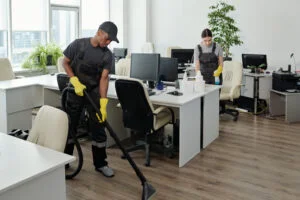
Are office cleaning and janitorial services different?
Sometimes, but not consistently.
Office cleaning commonly refers to recurring service in offices and administrative areas. It may include vacuuming, dusting, waste collection, restroom cleaning, breakroom cleaning, and care of shared spaces.
Janitorial services is often used more broadly for recurring cleaning and basic facility-support tasks in commercial buildings.
Custodial work may describe similar responsibilities, especially when the worker is assigned to one building and performs daytime monitoring, setup, supply, or minor support duties.
A cleaning technician may perform routine janitorial work, specialty cleaning, floor care, disinfection, or another defined service.
These descriptions are common, but they are not universal. A title alone does not establish what the person is expected, trained, equipped, or authorized to do.
Why terminology creates operational confusion
Problems begin when the client and cleaning provider attach different expectations to the same term.
A facility manager may believe janitorial service includes:
- Routine cleaning
- Consumable restocking
- Spill response
- Periodic floor care
- Interior glass cleaning
- Daytime monitoring
- Moving furniture
- Reporting maintenance conditions
The provider may be pricing only:
- Restroom cleaning
- Waste collection
- Vacuuming
- Mopping
- Dusting
- Breakroom cleaning
Neither party necessarily intends to create confusion. The problem is that the role was named without being operationally defined.
The title does not determine the responsibility
Changing janitor to custodian, cleaning technician, or another title does not improve performance by itself.
A useful role definition should answer:
1. Which areas is the employee responsible for?
2. Which tasks are completed during every service?
3. Which work follows a weekly, monthly, quarterly, or annual schedule?
4. Which products, equipment, and methods are approved?
5. Which conditions must be reported?
6. Which problems may the employee correct without additional approval?
7. Which requests require supervisor or client authorization?
8. Which maintenance, specialty, and facility-support activities are excluded?
These questions determine how the role operates. The title merely identifies it.
The principal service roles in a commercial cleaning program
A facility may use several service roles. One person can perform more than one role, but the responsibilities should still remain distinct.
Recurring office or janitorial cleaning
This role maintains the facility’s routine cleaning condition through scheduled tasks such as:
- Waste and recycling collection
- Restroom cleaning
- Breakroom cleaning
- Vacuuming
- Mopping
- Dusting
- Cleaning touchpoints and shared spaces
- Restocking approved consumables when included
The work normally follows a written scope and an agreed service frequency.
Day porter or occupied-hours support
A day porter maintains selected conditions while the building is being used.
Responsibilities may include:
- Monitoring restrooms and entrances
- Responding to spills
- Maintaining shared spaces
- Managing visible waste
- Restocking approved supplies
- Reporting developing facility conditions
- Supporting scheduled events or periods of concentrated activity
A day porter is not automatically responsible for every cleaning request made during the day. Coverage priorities, reporting requirements, and decision rights should be defined.
Periodic maintenance
Some work is necessary but does not belong in every recurring visit.
Examples include:
- Carpet extraction
- Floor scrubbing or refinishing
- High dusting
- Detailed cleaning behind movable items
- Interior or exterior window cleaning
- Upholstery cleaning
- Restorative restroom cleaning
Periodic work should be scheduled and priced deliberately. It should not remain invisible until buildup becomes severe.
Specialty or controlled-environment cleaning
Some environments require approved procedures, additional training, controlled products, documentation, access restrictions, or coordination with the client’s quality and safety teams.
These requirements may apply in healthcare, laboratory, manufacturing, pharmaceutical, food-production, or other controlled facilities.
Routine janitorial experience does not automatically qualify a provider to perform every controlled or specialty process. The facility and provider must clearly define the required procedure, training, authorization, documentation, and limits of responsibility.
Maintenance and facility repairs
Cleaning teams often observe maintenance conditions, but observation does not make the condition a cleaning responsibility.
Examples include:
- Plumbing leaks
- Broken dispensers
- Damaged flooring
- Failed lighting
- Loose fixtures
- Pest activity
- Water intrusion
- Heating or ventilation problems
- Surfaces that can no longer be restored through routine cleaning
The cleaning team should report these conditions through the agreed channel. The appropriate maintenance or facility representative should own the repair unless the cleaning contract expressly includes it.
What happens when roles are unclear
Routine work competes with unplanned requests
A cleaner assigned to complete a defined nightly scope may receive additional requests from several employees. If the requests are accepted without prioritization, planned work may be delayed or skipped.
The facility then experiences inconsistent cleaning even though the cleaner remained busy throughout the service window.
Periodic work is mistaken for routine cleaning
A floor may require machine scrubbing, finish restoration, or extraction. If the facility expects routine mopping to produce the same result, the cleaning provider may be blamed for a condition the assigned method cannot correct.
The same problem occurs when high dusting, detailed buildup removal, or restorative restroom work is assumed to be included in every visit.
Maintenance failures are assigned to cleaning
A leaking fixture can repeatedly create water on the floor. A damaged finish can continue looking dirty after cleaning. A broken dispenser can create a supply complaint.
The cleaning team may correct the immediate condition, but it cannot permanently resolve a problem controlled by maintenance or facility management.
Cleaners make unauthorized decisions
When responsibilities are unclear, frontline employees may decide independently whether to perform extra work, use a different product, enter a restricted area, move client property, or delay another task.
Even well-intentioned decisions can create safety, scope, quality, or billing problems.
Clients become the program’s supervisors
The client begins reminding cleaners about recurring tasks, checking completed work, resolving supply problems, and deciding priorities during each visit.
That hidden oversight burden is evidence that responsibilities and controls are not sufficiently defined.
Define responsibilities through the scope and operating plan
A complete commercial cleaning program should connect every service responsibility to an area, task, frequency, method, service window, and accountable party.
For each responsibility, establish:
- Area: Where does the responsibility apply?
- Task: What action must be completed?
- Frequency: When or under what condition is it performed?
- Method: Which process, product, or equipment is approved?
- Responsibility: Which person or party owns the work?
- Authority: What may the cleaner or supervisor decide independently?
- Escalation: What requires client direction or additional approval?
- Verification: How will completion or correction be confirmed?
- Exclusion: What related work is not included?
This structure prevents the role from expanding informally while important work remains unassigned.
Give frontline employees clear decision rights
A cleaning employee should not need management approval for every ordinary correction. The employee also should not be expected to make decisions involving uncertain scope, safety, cost, access, or responsibility.
Complete
The employee performs routine, safe, in-scope work using approved methods.
Report and correct
The employee reports an unusual condition and completes an authorized immediate response, such as controlling a spill or re-cleaning a missed area.
Stop and escalate
The employee pauses and requests direction when the condition involves:
- A safety concern
- Restricted access
- An unknown substance
- Possible property damage
- Unapproved chemicals or methods
- Additional cost
- Work outside the agreed scope
- Responsibility belonging to another contractor or department
Clear decision rights protect the facility while allowing routine problems to be resolved efficiently.
Preserve site knowledge when staffing changes
Consistent staffing can improve performance because employees learn traffic patterns, sensitive areas, access requirements, recurring problem locations, facility routines, and client communication preferences.
However, a reliable program cannot depend entirely on one employee’s memory. Site knowledge should also be preserved through location-specific scopes, building notes, access instructions, approved-product lists, equipment requirements, periodic-task schedules, reporting procedures, supervisor handoffs, and documented exceptions.
When staffing changes, the system should transfer what the previous employee learned.
Questions to ask when defining a cleaning role
Before assigning or purchasing a cleaning service, facility managers should ask:
1. What work is completed during every visit?
2. Which tasks occur less frequently?
3. Who monitors conditions during occupied hours?
4. Who supplies and restocks consumables?
5. Which spills or urgent conditions can the cleaner address?
6. What must the cleaner report without being asked?
7. Who can authorize corrective work?
8. What happens when access prevents completion?
9. Which maintenance and specialty services are excluded?
10. How are responsibilities transferred when staffing changes?
11. How will the client verify that the role is functioning as intended?
12. Who resolves a request that does not clearly belong to any defined role?
These questions are more useful than debating whether the correct title is janitor, custodian, office cleaner, or cleaning technician.
Closing perspective
Commercial cleaning roles should be defined by what the facility needs someone to accomplish, not by whichever title sounds most familiar.
Clear roles protect routine service from unplanned requests, distinguish cleaning from maintenance, separate recurring work from periodic maintenance, and give employees appropriate authority to respond.
The goal is not to establish one universal definition for every cleaning title. It is to ensure that the client, cleaning company, supervisors, and frontline employees share the same understanding of the work.
Schedule a Walkthrough
ATEB Cleaning Services can help facility managers in Massachusetts and Southern New Hampshire clarify cleaning responsibilities, service layers, reporting expectations, and decision rights.
Schedule a walkthrough with ATEB Cleaning Services to determine how routine janitorial service, occupied-hours support, periodic maintenance, and specialty work should fit together at your facility.